Choosing the right cone crusher is critical to crushing efficiency and overall production performance. Different cone crusher designs operate on different working principles, directly affecting capacity, product shape, and operating cost.
In mining and aggregate processing, cone crushers are widely used for secondary, tertiary, and fine crushing stages.
However, a cone crusher that performs well in one application may be unsuitable in another. Understanding how cone crusher working principles relate to specific applications is the foundation of proper equipment selection.
This guide focuses on the key technical factors that determine which cone crusher is best suited for different materials and crushing requirements. Let’s learn how to choose a cone crusher based on working principle and application.
| Model | Cavity mould | Mini Output Size (mm) | Feed Opening (mm) | Capacity (t/h) | Power (kW) |
| HPC200 | M | 16 | 120 | 140-220 | 160 |
| HPC300 | C | 20 | 210 | 190-380 | 250 |
| HPC400 | C | 25 | 251 | 295-560 | 315 |
| HPC500 | M | 22 | 210 | 345-605 | 400 |
Cone Crusher Working Principle Explained
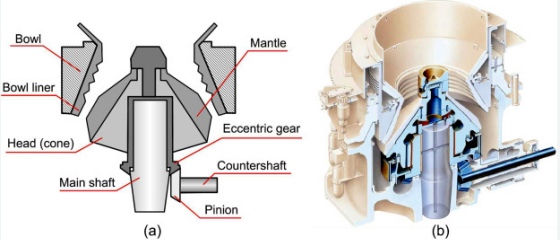
A cone crusher operates on the principle of continuous compression crushing. Material is fed into the crushing chamber and squeezed between a moving mantle and a fixed concave.
The mantle moves in an eccentric circular motion driven by the main shaft and eccentric assembly.
This motion creates a constantly changing crushing gap, allowing material to be crushed, released, and further reduced in a continuous process.
Crushing occurs in multiple stages within the chamber rather than in a single impact.
This results in higher crushing efficiency, better product shape, and more uniform particle size.
Different cone crusher designs adjust the crushing force and chamber profile through variations in hydraulic systems, eccentric throw, and liner configuration. These design differences explain why cone crushers perform differently under various materials and applications.

Advantages of Cone Crusher Equipment
High Performance and Low Cost
The combination of optimized cavity type, reasonable speed and stroke, the performance is stable and reliable, the production capacity is improved, and the production cost is reduced. Using the principle of lamination and crushing, the number of cubic finished products is increased, the particle size is uniform, and the gradation is reasonable.
Safe and Reliable Operation
Large-diameter spindle and heavy-duty main frame ensure that the equipment is durable and reliable in operation. Independent thin oil lubrication system with multi-point control can ensure double protection of bearing lubrication. Over-iron protection device and automatic control system can realize automatic safety protection.
Easy to Operate and Maintain
All components can be disassembled from the upper or side to facilitate the removal of fixed cone and moving cone assemblies. The hydraulic cavity cleaning system can quickly clean the broken cavity and greatly reduce the downtime.

How Working Principle Influences Crushes Performance
The working principle of a cone crusher has a direct impact on how the machine performs under real operating conditions.
Key performance differences are mainly reflected in capacity, product quality, energy consumption, and wear behavior.
Crushing Capacity and Throughput
Continuous compression allows cone crushers to maintain stable material flow. Eccentric throw and chamber design determine how much material can be processed per hour.
A larger crushing stroke generally increases capacity, while a more compact chamber improves control over fine crushing.
Product Shape and Gradation
Multi stage compression within the crushing chamber produces more cubical and uniform aggregates.
This is especially important for applications requiring high quality end products.
Chamber profile and liner selection play a critical role in controlling final particle size distribution.
Energy Efficiency
Cone crushers apply crushing force gradually rather than through sudden impact.
This reduces energy loss and improves power utilization, particularly in continuous operation.
Efficient force distribution also helps maintain stable performance under variable feed conditions.
Wear Parts Life and Maintenance
Evenly distributed crushing pressure reduces localized wear on liners.
Properly matched working principle and application extend wear part service life and reduce downtime.
Incorrect application often results in premature liner wear and unstable operation.
Types of Cone Crushers Based on Application
Cone crushers are used across different crushing stages and material processing requirements.
Application type determines chamber design, crushing force, and operational configuration.

Cone Crushers for Tertiary and Fine Crushing
Tertiary and fine crushing aim to achieve precise particle size and improved product shape.
These applications emphasize:
- Controlled crushing chamber geometry
- Reduced discharge opening
- Consistent gradation
Cone crushers in fine crushing stages are optimized for shape control and size uniformity rather than maximum throughput.

Cone Crushers for Secondary Crushing
Secondary crushing focuses on reducing medium size feed material from primary crushers.
These applications typically require:
- High throughput
- Stable reduction ratio
- Robust chamber design
Cone crushers used in secondary stages are designed with larger feed openings and higher crushing force.
They prioritize capacity and durability over fine particle control.

Cone Crushers for Mining Applications
Mining operations often involve hard abrasive materials and continuous high load operation.
Cone crushers used in mining require:
- Strong mechanical structure
- High wear resistance
- Stable performance under variable feed conditions
Reliability and wear part life are critical factors in mining environments.

Cone Crushers for Aggregate and Quarry Applications
Aggregate production focuses on consistent output quality and cost efficiency.
Cone crushers in quarrying applications are selected based on:
- Required aggregate specifications
- Production capacity
- Integration with screening systems
Product shape and operational stability are often prioritized in aggregate processing.
How to Choose a Cone Crusher for Different Applications
Proper cone crusher selection requires matching the working principle with actual operating conditions.
Material characteristics, production targets, and system configuration should be evaluated together.
Material Hardness and Abrasiveness

Material properties are the primary factor in cone crusher selection.
Hard and highly abrasive materials require:
- Strong crushing force
- Rigid machine structure
- Wear resistant liner materials
For softer or less abrasive materials, efficiency and product shape become more important than extreme crushing strength.
Required Capacity and Output Size
Production capacity and target product size define the crusher configuration.
Higher throughput demands:
- Larger crushing chambers
- Appropriate eccentric throw
- Stable feeding conditions
Fine output size requires tighter discharge settings and optimized chamber profiles.

Feed Size and Upstream Equipment
Feed conditions directly affect crusher performance and wear.
Cone crushers are typically fed by jaw crushers or impact crushers.
Feed size and uniformity must match the selected cone crusher design to avoid overloading or inefficient crushing.
Automation and Control Requirements
Modern cone crushers often use hydraulic and automated control systems.
These systems allow:
- Discharge opening adjustment
- Overload protection
- Real time performance monitoring
Automation improves operational stability and reduces manual intervention.

Operation and Maintenance Considerations
Long term operating cost is as important as initial equipment selection.
Factors to consider include:
- Wear parts replacement frequency
- Ease of maintenance
- Downtime during liner changes
A properly selected cone crusher reduces overall operating cost and improves production continuity.
Common Mistakes When Selecting a Cone Crusher
Incorrect cone crusher selection often leads to low efficiency, excessive wear, and unstable operation.
Many issues arise not from equipment quality, but from mismatched application conditions.
Ignoring Material Characteristics
Selecting a cone crusher based only on capacity without considering material hardness and abrasiveness is a common mistake.
Hard or abrasive materials can cause:
- Rapid liner wear
- Increased operating cost
- Frequent downtime
Material properties should always be evaluated before finalizing crusher type and configuration.
Oversizing or Understanding the Crusher
An oversized cone crusher may operate under low load, reducing efficiency. An undersized crusher may suffer from overload, liner damage, and unstable performance.
Crusher size should match:
- Actual production demand
- Continuous feed rate
- System layout
Balanced sizing ensures stable and economical operation.
Incorrect Crushing Stage Applications
Using a cone crusher designed for secondary crushing in fine crushing applications often results in poor product shape.
Likewise, applying fine crushing chambers in secondary stages limits capacity.
Each crushing stage requires a specific chamber design and working principle.
Poor Feed Distribution
Uneven or segregated feed causes localized wear and unstable crushing pressure.
Proper feeding systems help:
- Improve liner utilization
- Stabilize product gradation
- Extend equipment service life
Feed conditions are as important as crusher selection itself.
Overlooking Long Term Operating Cost
Focusing only on initial purchase price can lead to higher long term expenses.
Wear parts, maintenance frequency, and energy consumption should be considered as part of the total cost of ownership.
FAQs About Cone Crusher Selection and Application
What materials are suitable for cone crushers?
Cone crushers are suitable for medium to hard and abrasive materials such as granite, basalt, iron ore, and river stone.
Material hardness and abrasiveness determine chamber design and liner selection.
Can one cone crusher be used for different crushing stages?
A single cone crusher can be adjusted within a limited range, but it cannot efficiently replace all crushing stages.
Secondary, tertiary, and fine crushing require different chamber profiles for optimal performance.
How does working principle affect product shape?
Compression based crushing produces more uniform and cubical particles compared to impact crushing.
Chamber geometry and crushing force distribution strongly influence final product quality.
What determines the capacity of a cone crusher?
Capacity is affected by feed size, material characteristics, eccentric throw, chamber design, and discharge setting.
Stable and continuous feeding is essential to achieve rated capacity.
How often do wear parts need to be replaced?
Wear part life depends on material abrasiveness, operating conditions, and liner material.
Proper application and feed control significantly extend liner service life.
Is hydraulic adjustment necessary?
Hydraulic systems allow easy discharge opening adjustment and overload protection.
They improve operational safety, stability, and maintenance efficiency.
Contact Us for More Details about Cone Crushers
Choosing the right cone crusher requires understanding both the working principle and the intended application.
Material characteristics, required capacity, feed conditions, and desired product quality all influence selection.
Proper matching of crusher type, chamber design, and operational settings ensures stable performance, efficient production, and longer wear part life. A systematic approach to cone crusher selection improves overall project efficiency and optimizes long-terms operational costs.
Careful evaluation of each factor before purchase reduces the risk of underperformance, excessive maintenance, and unnecessary downtime.
Related: